
One factor that significantly affects firewood production efficiency is the size of the wood used. This blog post offers some perspectives on how the diameter of the wood affects production volume, production costs, and the quality of the firewood itself.
When considering the impact of log size on firewood production, the starting point can be considered that a larger diameter log generally makes it possible to increase production efficiency, improve firewood quality, and achieve clear savings in production costs compared to a narrower log.
With a larger log, you achieve clear savings in production costs
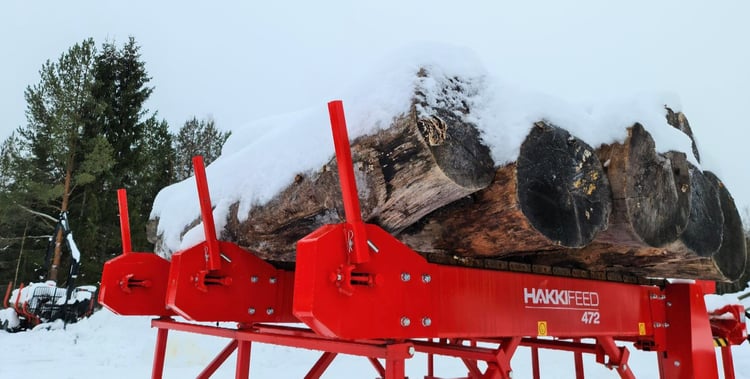
A larger raw material generally brings a wide variety of benefits to production. From a larger log, it is possible to achieve a better yield in the same amount of time. There are several explanatory factors for this.
First of all, the transportation costs of raw materials do not vary depending on the size of the log. Therefore, the transportation costs from the forest all the way to the customer's home or other firewood usage site are the same for a larger log. In other words, more raw material is transported for the same money, which brings clear savings to production costs.
The second largest raw material produces more and higher quality end product, i.e., firewood, in the same amount of time. For example, a faster machine used for small logs makes the same amount of wood from 25 cm wood with 10 cuts per minute as a slower machine makes from 30 cm wood with 7 cuts per minute. If the log diameter is increased from 30 centimeters to 40 centimeters, production almost doubles.
The table below shows how the log diameter affects the efficiency of firewood production.
Additionally, with a larger log on the log table, a smaller number of logs needs to be loaded. Consequently, you can spend less time filling the table and moving new wood to sawing. This also clearly saves labor costs.
Higher quality firewood from larger logs
.jpeg?width=750&name=Hakki-Pilke_HakkiMultiBlade%20(2).jpeg)
A larger raw material therefore has clear effects on production volume and production costs. In addition, a larger log yields clearly higher quality firewood. Larger wood is often tighter-grained and has less bark.
A higher quality final product is also directly reflected in the bottom line, as you can charge more per cubic meter for a quality product.
Our blog How to make a firewood business successful? you will find tips for calculating production costs by optimizing processes.